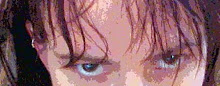
Weaving letters is always a bit of a challenge and has been the subject of many tapestry weaving workshops. However it is more time consuming than it is difficult to do. As long as you follow the lines on the cartoon behind the work and ensure the warp count is high enough to avoid obvious jumps across the warp threads, it is no more difficult than blending or hatching techniques can be. The speech bubble shown below here is part of a portrait weaving I will be exhibiting in the Four Directions show.
Showing posts with label weaving on loom. Show all posts
Wednesday, March 7, 2012
Friday, February 25, 2011
Tapestry Weaving from Drawn or Painted Design to the Finished Woven Image.
Above is a cartoon I have documented as it is being woven in the photos below. The original painting has been adjusted in Photoshop to produce a workable cartoon. This process helps to clarify and select clear boundaries within the painting. By simplifying the original painting with Photoshop or a similar program I was able to create an image that still retained the integrity of the original painting, while at the same time creating a weavable cartoon which better suited the technical restraints of the low warp count I was working on.
Note that in this instance the weaving has well and truly deviated from the exactness of the detail, especialy in the dogs main body area. There are 3 reasons for this. The first is that the warp count was too low (there should have been more vertical threads). The second is because the size of the weaving space is too small (it would need to be a much bigger weaving to allow for the detail to be included). And thirdly, it was a play piece of my own, which enabled me to have the freedom of extreme artistic license. It now belongs to Su anyway, who lives near the dingo isle of Fraser, and who also happens to have been born in the year of the Dog.
1.
2.
3.
THE MAIN BODY AREA OF THE DOG HAS BEEN WOVEN USING HAND-SPUN DOG HAIR. OTHER YARNS USED ARE RAYON, WOOL, COTTON AND SILK.
Tapestry weaving WORK IN PROGRESS.
![]() |
| 1. |
![]() |
| 2. |
![]() |
| 3. |
![]() |
| 1. |
![]() |
| 2. |
![]() |
| 3. |
Sunday, January 31, 2010
E.P.I. EXPLAINED

Ends per inch or e.p.i. are used to indicate the number of warps (vertical threads) that the tapestry weaving is woven onto for every inch you measure across the completed work.
For example the rug you can see being woven on the loom here is set at approximately 5 e.p.i. This means that for every inch across the entire horizontal row of the warp threads there are 5 vertical threads. This is referred to as a low warp.
It also means that creating vertical lines in this particular rug design should be avoided as much as possible. The low number of e.p.i. will always dictate the limitations of the end design.
Subscribe to:
Posts (Atom)
Tapestry Weavings By Stephenie Collin
I hope you find Warped Art & Design both interesting and inspiring, and that it will encourage anyone working with fibre to investigate and experiment further within their chosen field.
The basic loom, which is my tool of trade, has remained technologically unchanged. This aspect appeals to me as I weave contemporary images on a machine of such simple and ancient construction.
And if the loom be silenced,
then needles, threads and fingers
have plenty more to say.
About Me
- warpedart&design
- Waiuku, Auckland, New Zealand
- I am an artist, weaver, gardener, mother and grandmother, home food gatherer, political sceptic, modest future eater, and much much more.