Showing posts with label tapestry designs. Show all posts

Sunday, April 21, 2013

Referencing Tales, Myths & Legends

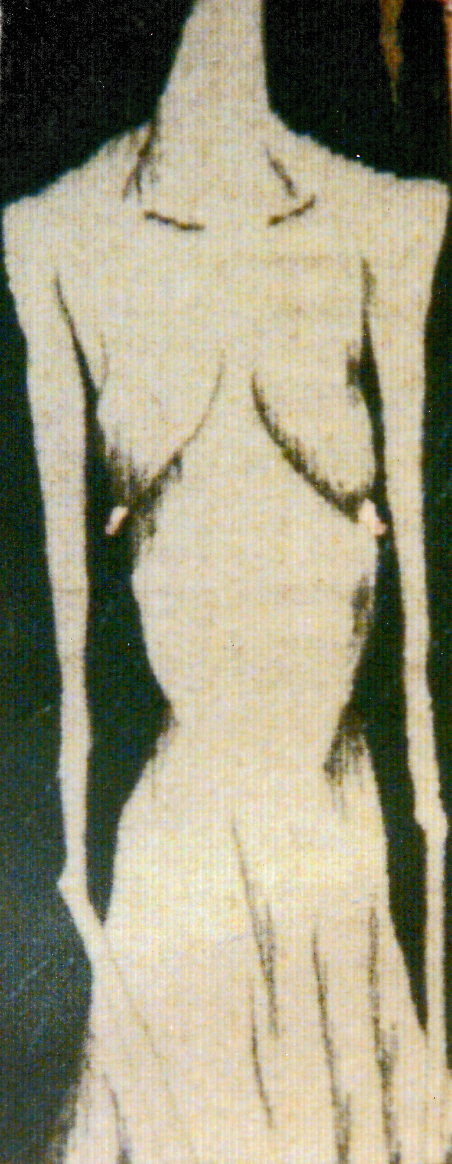
Fairy tales & legends connect the past and present. I feel I can relate to the closeted life of Rapunzeland, that sense of entrapment and the oppressing obligation of having to live according to societal rules. And the traditional story of Nanook will always be over-shadowed by lines from Frank Zappa. 

In Search of Nanook

Woven at 11 e.p.i. on a cotton warp, using hemp, cotton, wool and rayon. These two weavings were woven as a twin-set pair. These two works are reminiscent of my 1960's childhood, where fact and fantasy were forever blurred. Reality and authoritative norms were full of contradictions. In my smallness, joining lifes dots together seemed an impossible task.

Rapunzel Gets a Life

Thursday, July 19, 2012

Shaped Tapestry Weavings


I have used shaped edges on my tapestries from time to time, usually along the beginning and end edges of the weaving, such as the weaving below, which was obviously woven side-ways.

Rapunzel Gets A Life
It was one of two weavings that had a dark nursery theme. They were both framed behind glass, mounted onto and surrounded by a generous sized matt-gold  board, with quite a heavy gold frame which gave them an even more surreal presence on the wall. 

In Search Of Nanook


Of course things get a little trickier when both ends of the weaving need to be shaped. Diane Ammar is a NZ tapestry weaver who has self-published at least two books on her particular technique for shaped weaving. Some are delightfully fine and intriguing works. This is the link to the American Tapestry Alliance site review. http://www.americantapestryalliance.org/Members/NLv31n4/NLv31n4p8.html


Window 2 -  Part of installation at Franklin Steel Gallery.


Tuesday, June 26, 2012

The Link Between Sketchbook and Weaving


Sketchbook drawing
Finished weaving based on sketch above
All sketches have the potential to be used as a basis for weaving a final design. These sketches were part of a series of work that still continues to be a point of reference for me. 

The initial workbook drawings, some of which are shown here, were the result of driving through the Tokoroa/Taupo area where the forestry blocks of pines were being clear-felled for miles around. Although a sustainable crop, the visual effect of recent harvest on such a grand scale was dramatic and brutal. 

This same scenery I remember as a child was a new plantation, bristling the hillside like a scalp-hugging razored hair cut. 
As a teenager the  trees grew to cover the steep gullies and flat plains with an even covering of young healthy looking trees. 
As an adult the landscape became thickened by the undergrowth, the trees looked permanent, strong and sadly non-diverse, a mono-toned investment that looked close to harvesting a return. 
The harvest of this scenery was always part of the plan, always expected, but the totality of it's sudden removal was a violent and apocalyptic scene. Mother earth had been brutalised and it was impossible for me to not record it in some way. 

Sketch for Tokoroa series


Weaving: From 4th With Love

When people have viewed these weavings at exhibition, they have shown a mixed response. Some have been intrigued or captivated, others disturbed and uneasy. For me, neither reaction an audience shows towards the work is more desired than the other. The intent for me is for the viewer to feel a connect with the essence of the piece. Did they experience similar feelings as I felt when I saw the the results of the clear-fell harvest. They certainly wouldn't have identified the with images as forest trees, but they may have had feelings of emaciation, or recognised attributes of the feminine being ravaged or threatened in some way. 
Sketch detail


Weaving detail
At exhibition you normally have the opportunity to read about the ideas behind the series of work you are viewing. Often the work itself is self-explanatory, or can be viewed without any explanation so that the viewer forms their own opinion of what the image is saying. 

However it is always a good idea to make use of any background information the artist has to share, as it can often give you a completely different perspective on the the work. Artist statements offer insight and information that helps the viewer to better understand what it is they are viewing. 
Weaving in progress on loom


Idea taken from section of sketch book page

.
Postcards From The Mothership
Completed weaving from Tokoroa series.

Friday, February 25, 2011

Tapestry weaving WORK IN PROGRESS.

1.

2.

3.

The two tapestries were woven side by side.  Numbered 1-3 above and below, you can follow the works progression and clearly see the cartoon behind the weaving indicating the design lines which need to be followed. With these smaller pieces I usually avoid marking the actual warp threads as the cartoon is small enough to flip up and down into view to use as an adequate enough guide.

1.

2.

3.

Sunday, September 5, 2010

To Glass or Not To Glass- That is the question.

Butcher, Baker, Candlestick Maker - The Crown Wants a Piece Of it All
Tapestry weaving is arguably the most obvious technique that readily lends itself to being shown as fine art. I recently discussed exhibiting practices and the presentation of  tapestry weavings with another tapestry weaver. We queried whether our work should always be shown in a way that allowed the tactile element of the work to over-ride all other considerations. Does unprotected framing remain the best way to present contemporary, smaller, non-functional works?

Should the most important element of the work even be the weaving?

From a traditional and purists point of view, tapestry weavings should not be shown behind glass. In many circles and obviously at the judged national exhibition level,  there is a continued expectation that tapestry weavings should be presented in a manner that best connects veiwers to the the fibre/craft element of the work. 

I have always struggled with this as a hard and fast rule especially if conveying the message of the piece is more important to me than the fact that I happened to chose tapestry weaving as the medium to convey that message.

As a hand-woven tapestry work that is made special by "Please  Do Not Touch" signs, does the weaver take the initiative to present the work from behind glass, in a manner that  acheives the same result.
Is it a matter of educating veiwers/judges to accept the work as it is intended to be viewed as a whole by its creator or should the creators still be striving to educate viewers of their fibre art through the traditional and accepted manner of presenting the work open to the elements and inquisitive fingers?

At the end of our discussion we rightly or wrongly concluded that the craft artist would probably argue in favour of the status quo, i.e that to present a tapestry weaving behind glass deminishes the work. Whereas  the artist/weaver would probably be more inclined to want the piece protected and presented to the viewer framed behind glass if that was how the piece worked best in relation to their intended artistic statement or concept.

Tuesday, July 13, 2010

The Selection Process

Black & white photo.
The selection process for portrait design is reasonably straight forward. The original photos are sorted through to determine which one has captured that special quality that best describes the essence of the sitter.

The photo is then adjusted to give the aesthetic that the client would want to live with within the context of other interior design requirements. No matter how good the image or how well mastered the weaving is, if it fails to represent the interior space it will  be hung in, then the whole exercise will have been futile from a design perspective.


The size of the weaving is usually associated with cost, however it is best to predermine what the client is prepared to pay before the photo is adjusted. At that stage the image can be striped back further to simplify the image and thus require less weaving time. Other cost reduction considerations could be the cropping of the image. One should never under-estimate how much of the person is held in the image of say just the eyes or a partial profile.

Saturday, June 12, 2010

Monday, February 1, 2010


Some time during the mid/late nineties a Keith Haring Exhibition was shown in Wellington if I remember rightly. His simplicity of line and movement was incredibly inspiring for me.
Social comment in an abstract or sparse art work, subtle or otherwise, has the ability to show time and place in a multi layered type of way. This weaving from Inquision/Supperstition is one of a pair.

I have been interested in working collaboratively with someone on a larger mural-type weaving for quite a while now. If there are any community mined artists out there with roots in the street art movement and who have a mature and focused desire to work on a joint project involving tapestry weaving, get in touch.

Tapestry Weavings By Stephenie Collin


WELCOME TO MY BLOG....


I hope you find Warped Art & Design both interesting and inspiring, and that it will encourage anyone working with fibre to investigate and experiment further within their chosen field.


The basic loom, which is my tool of trade, has remained technologically unchanged. This aspect appeals to me as I weave contemporary images on a machine of such simple and ancient construction.

And if the loom be silenced,
then needles, threads and fingers
have plenty more to say.


About Me

My photo
Waiuku, Auckland, New Zealand
I am an artist, weaver, gardener, mother and grandmother, home food gatherer, political sceptic, modest future eater, and much much more.